
AI Is Not Just a Multiplier. It Is an Enabler.
We already established that most people still use AI like an advanced Google. They optimize for a perfect answer from the first prompt, which is usually the wrong target.
They ask a question, receive an answer, and leave. At the other end, advanced users build agent factories, harnesses, and loops that keep working across many tasks.
What bugs me is that both groups can make the same mistake. They treat the first prompt as the place where all the intelligence has to live. When the output misses, they rewrite that prompt or request a larger batch. The goal remains a perfect result in one shot.
In most useful work, the first prompt creates the first thing worth reacting to. The thinking happens through iteration, and that iteration needs a structure.
I noticed this while thinking about background music for a launch video.
The sound in my head is strangely specific: something like Loser by Tame Impala and Derezzed by Daft Punk had a baby. Psychedelic and loose in one place. Metallic, synthetic, and urgent in another.
There is one problem. I do not know how to make music. I have never learned Logic Pro well enough to produce that track myself.
I could give an agent bounded wallet and spending authority through OpenSpender, plus a fal API key that lets it call an audio model. The agent could pay for generations and return the files without me wiring each request by hand.
The obvious workflow is one large prompt describing the whole idea, followed by a request for several variations. Then I listen to the outputs and pick the least bad one.
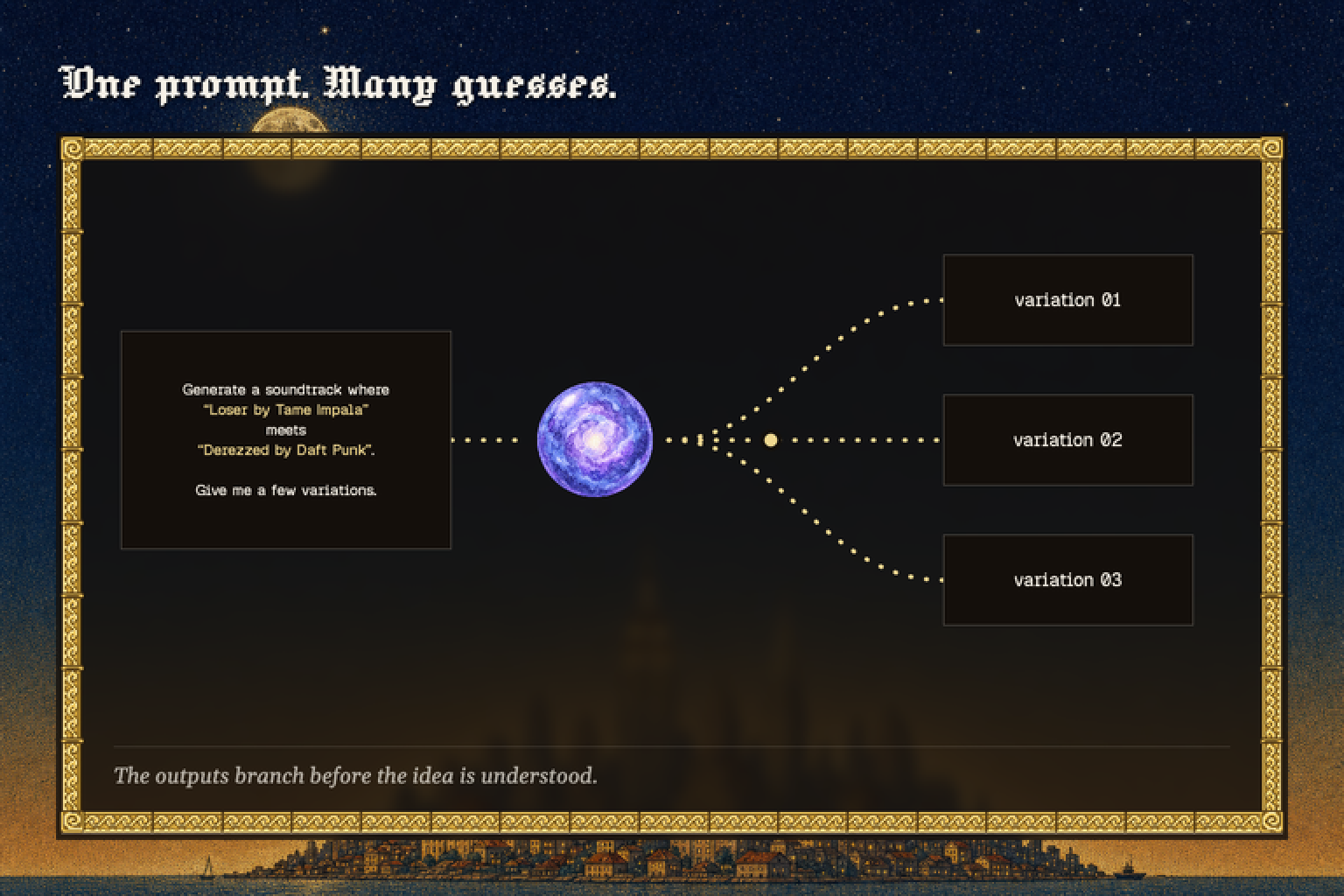
That sounds efficient because all the generation happens at once. It also asks the model to make nearly every creative decision at once: the groove, tempo, synth texture, bass, density, arrangement, and the relationship between two references that work for completely different reasons.
If the agent gives me ten tracks, I may hear one I like. I will probably have a harder time explaining why I like it or how to move it closer to the thing in my head.
The interesting work begins after the first useful output.
The prompt is hiding several questions
“Make a track that combines Loser by Tame Impala and Derezzed by Daft Punk” feels like one request. It is actually a stack of unanswered questions.
What do I want from Loser by Tame Impala? The loose rhythm? The distorted warmth? The vocal attitude? The way the song drifts?
What do I want from Derezzed by Daft Punk? The clipped synths? The pace? The mechanical pulse? The pressure it creates?
How should those parts meet? Which reference should control the base, and which one should modify it?
I do not know the answers before hearing anything. That is important. A better first prompt cannot contain knowledge I have not discovered yet.
A random batch can be useful at the beginning. It often tells me very little about why one output works. Deliberate branches turn each comparison into information.
Start from the first useful node
I would start with the simplest version that gives me something real to react to. Call it the first useful denominator.
For example: make an instrumental EDM/synth interpretation of Loser by Tame Impala. Give it enough structure that I can judge the rhythm, texture, and energy.
That output becomes the first node.
Then I branch from it by changing one meaningful variable at a time.
- Rhythm: keep the sound, move the pulse toward Derezzed by Daft Punk.
- Synth texture: keep the arrangement, try sharper and more clipped tones.
- Density: keep the groove, compare a sparse low end with a heavier one.
- Arrangement: keep the palette, change where the track builds and releases.
Each branch answers a question. When one version gets closer, I keep it as the next base node and branch again.
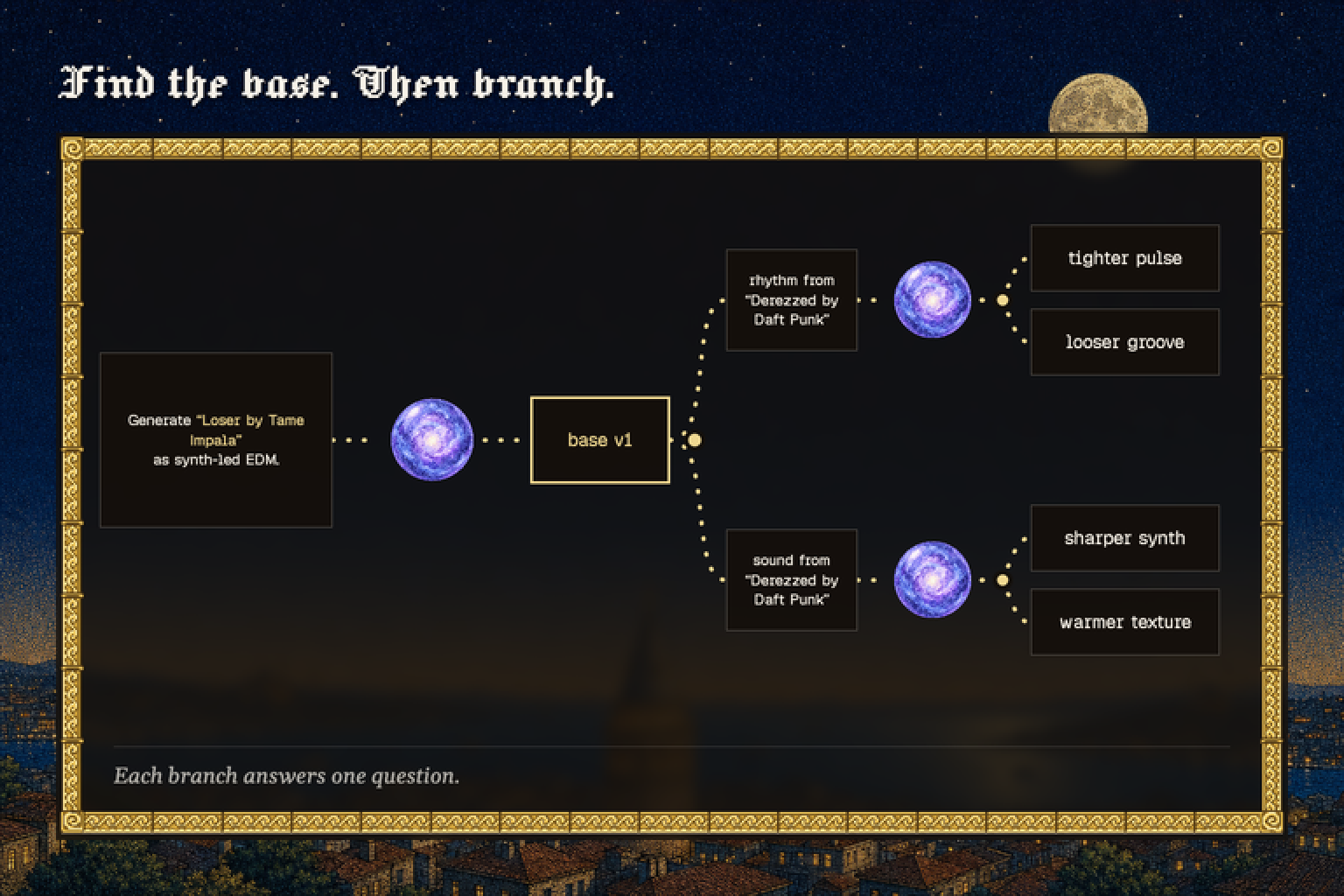
The process may take longer than generating ten unrelated tracks. It is also doing a different job. I am learning what I meant while the agent helps me make it.
This is why constantly rewriting the original prompt feels wrong to me. It erases the path. Every revision asks the system to reinterpret the whole idea again. A tree preserves what worked, what changed, and why the next branch exists.
Iteration needs a shape
“Keep iterating” is not much of a method. The loop needs memory.
For each node, I want five things recorded:
- the parent output
- the variable that changed
- the instruction used for that change
- what I liked or rejected
- the question the next branch should answer
This turns taste into something the agent can work with.
Taste is usually hard to state in advance. I might say I want a harder sound, hear the result, and realize the real issue was the rhythm. That correction should stay attached to the branch where I learned it.
It changes how I evaluate the output too. “Is this good?” is too large a question. “Did this version tighten the rhythm without losing the warmth?” is answerable. A narrow question makes taste easier to communicate. Even a failed branch can be useful because it rules out one direction while the last good base remains intact.
An agent is very good at copying a useful base and producing controlled variations. The human contribution is choosing the variable, noticing the difference, and deciding which direction deserves another branch.
Over time, the tree becomes a map of the idea. The final output matters. The path also teaches me enough vocabulary to make the next decision better.
The expert’s objection
People who already know a craft often look at this workflow and say they could do the same work in the same amount of time.
They are probably right.
A producer who knows Logic Pro may hear my description, open the right instruments, shape the groove, and get close faster than I can through an audio model. A designer can fix a composition directly. An editor can cut a video without explaining every decision to an agent.
That comparison starts from their skill level.
My starting point is different. I have an idea and some taste. I do not yet have the technical ability to produce the work. AI gives me a way to learn the basic vocabulary while making something, with the output itself acting as feedback.
The craft still matters. An expert will see options I cannot see, reject bad directions earlier, and control details I may never notice. But lack of expertise no longer means the idea has to remain trapped in my head until I hire someone or spend months learning the tool.
There is a new middle ground. You can learn enough to direct, compare, and improve a result before you can perform every operation yourself.
AI is not just a multiplier. It is an enabler.
AI changes the waiting part too
The second objection is time. A structured tree can take many generations. If I sit and watch every branch render, the workflow becomes a very expensive loading screen.
That is not how I want to work with agents.
While one session generates the next audio branch, I can open another session for the launch script. A third can work on diagrams. Another can review a landing page or prepare distribution notes.
This does not require me to multitask inside four problems at once. I need to define bounded jobs, hand them off, and return when a decision is ready. The work runs in parallel even when my attention does not.
Humans are used to software waiting for us. Now we have to learn how to organize work that continues while we move elsewhere.
That may feel less natural at first. I think it becomes one of the most important operating skills for agent users: keeping several branches moving without becoming the bottleneck for all of them.
The two modes compound
Inside a field I already understand, AI multiplies my existing judgment. I can produce more drafts, test more approaches, inspect more code, and compress the repetitive parts of the work.
The bigger surprise appears outside that field. Music, design, GTM, video editing, and animation become reachable because I can turn an idea into a sequence of outputs I know how to compare.
Used together, these modes change the shape of a small company.
One person can go unusually deep in the function where they have real expertise. The same person can reach far enough into adjacent functions to make a coherent product, story, launch, and experience. Specialists still raise the ceiling. The founder is no longer blocked at the floor.
That is the part I think people give a bad reputation. They see a nonexpert taking longer than an expert and call the workflow pointless. They ignore the thing that now exists because someone with taste finally had a way to make it.
The next single-person billion-dollar company will probably come from someone who uses AI in both modes: multiplication where they are excellent, and enablement everywhere the idea needs to travel.
A single-person trillion-dollar company sounds ridiculous today. I am leaving it in.
The boundary of what one person can make is moving.